


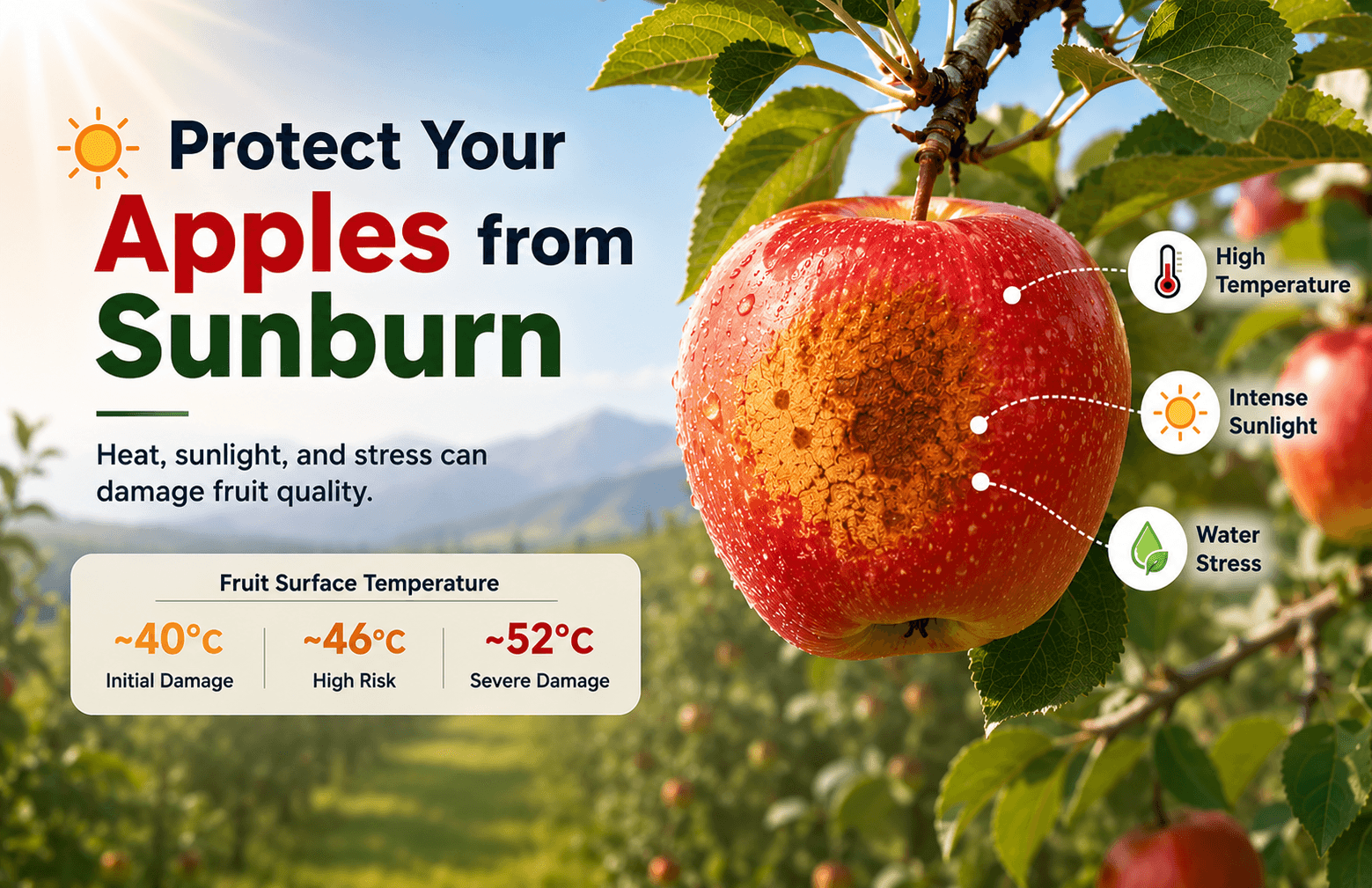
Apple sunburn has become one of the fastest-growing challenges facing apple growers across the world. As climate change drives more frequent heat waves, prolonged dry spells, and extreme weather events, sunburn damage is increasingly affecting fruit quality, marketability, and orchard profitability.
In regions like Jammu & Kashmir, where premium apple varieties are cultivated under high-density orchard systems, even a few days of intense summer heat can result in significant economic losses.
The good news is that sunburn is largely preventable. Understanding why it occurs, recognizing the early warning signs, and using weather-driven decision support can dramatically reduce damage.
In this guide, we’ll explore everything growers need to know about apple sunburn, including its causes, symptoms, prevention strategies, scientific temperature thresholds, and how Orchardly uses environmental intelligence to predict sunburn risk before damage occurs.
What is Apple Sunburn?
Apple sunburn is a physiological disorder caused when the fruit absorbs more solar energy than it can dissipate, resulting in excessively high fruit surface temperatures (FST).
Unlike fungal diseases or insect damage, sunburn is not infectious. It occurs when environmental conditions push the fruit beyond its physiological tolerance, causing cellular injury in the peel and underlying tissues.
Because sunburn directly affects fruit appearance, it significantly reduces market grade and often leads to poor storage performance.
Why Does Apple Sunburn Occur?
Many growers assume that air temperature alone determines sunburn risk.
In reality, fruit surface temperature is the critical factor.
An apple exposed to direct afternoon sunlight can become 10–17°C hotter than the surrounding air, particularly during clear skies with low wind and low humidity.
For example:
- Air Temperature: 34°C
- Fruit Surface Temperature: 46–50°C
This difference occurs because the fruit continuously absorbs solar radiation while losing heat through convection and transpiration. When absorbed energy exceeds cooling capacity, the fruit begins to overheat.
Trees experiencing water stress are particularly vulnerable because reduced transpiration limits the natural cooling effect.
Scientific Temperature Thresholds for Apple Sunburn
Extensive research by Schrader et al. established industry-recognized fruit surface temperature thresholds that are now widely used in apple production.
| Fruit Surface Temperature | Expected Damage |
|---|---|
| ≈40°C | Initial sunburn browning may begin under susceptible conditions |
| ≈46°C | High probability of sunburn browning |
| ≈52°C | Severe tissue injury and sunburn necrosis |
These temperatures refer to the surface of the fruit—not ambient air temperature.
This distinction is extremely important because fruit surface temperatures often exceed ambient temperatures by more than 10°C.
Types of Apple Sunburn
1. Sunburn Browning
The most common form of heat injury. Typical symptoms include: Yellow or bronze discoloration, Brown patches on the sun-exposed side, Smooth skin texture & Minimal internal damage.
Although edible, these fruits lose significant commercial value.
2. Sunburn Necrosis
The most severe form. Symptoms include: Dark brown or black patches, Dead skin tissue, Sunken lesions, Leathery texture & Increased susceptibility to storage rots.
These fruits are generally unsuitable for fresh markets.
3. Photooxidative Sunburn
This occurs when previously shaded fruit is suddenly exposed to intense sunlight. Common causes include: Heavy summer pruning, Broken branches, Wind damage, Hail damage
Initially, fruit develops pale or bleached patches that later turn brown.
Factors That Increase Sunburn Risk
Several environmental and orchard factors contribute to sunburn:
- High air temperatures
- Intense solar radiation
- Low relative humidity
- High vapour pressure deficit (VPD)
- Water stress
- Hot, dry winds
- Sparse tree canopies
- Heavy summer pruning
- South- and west-facing fruit exposure
- Young orchards with limited canopy development
- Consecutive heat-wave events
Usually, it is the combination of these factors—not a single weather variable—that results in severe damage.
Which Apple Varieties Are More Susceptible?
Although all apple varieties can experience sunburn, susceptibility varies depending on skin colour, maturity, fruit exposure, and canopy structure.
In Kashmir, premium cultivars such as Gala, Red Delicious, Golden Delicious, Fuji, and other high-density orchard varieties can all suffer substantial quality losses during prolonged heat events if exposed fruit is not adequately protected.
Impact of Sunburn on Yield and Profitability
Sunburn affects far more than fruit appearance.
Growers may experience:
- Lower pack-out percentage
- Downgrading of premium fruit
- Reduced storage life
- Higher post-harvest losses
- Increased susceptibility to decay
- Greater moisture loss
- Reduced consumer acceptance
- Significant reduction in orchard profitability
Even a moderate incidence of sunburn can translate into substantial financial losses at harvest.
How to Prevent Apple Sunburn
Effective prevention requires an integrated orchard management strategy.
- Maintain a Healthy Canopy: Avoid excessive summer pruning that suddenly exposes fruit to direct afternoon sunlight.
- Maintain Adequate Soil Moisture: Proper irrigation improves transpiration, helping trees cool both leaves and fruit naturally.
- Reduce Tree Stress: Balanced nutrition and healthy root systems improve the tree’s resilience during periods of heat stress.
- Plan Orchard Operations Carefully: Avoid major pruning, branch removal, or canopy disturbances immediately before or during forecast heat waves.
- Monitor Weather Continuously: Heat damage is often the result of several consecutive high-risk days rather than a single hot afternoon.
Using reliable weather intelligence enables growers to take preventive action before fruit temperatures become critical.
Why Air Temperature Alone Cannot Predict Sunburn
Traditional weather forecasts typically display only ambient air temperature.
However, air temperature alone is a poor indicator of sunburn risk.
Fruit surface temperature depends on a complex interaction of: Solar radiation, Relative humidity, Vapour Pressure Deficit (VPD), Wind speed, Cloud cover, Fruit exposure, Canopy density, Orchard orientation, Irrigation status & Terrain and local microclimate
This explains why two nearby orchards can experience very different levels of sunburn under the same regional weather forecast.
How Orchardly Predicts Apple Sunburn Risk
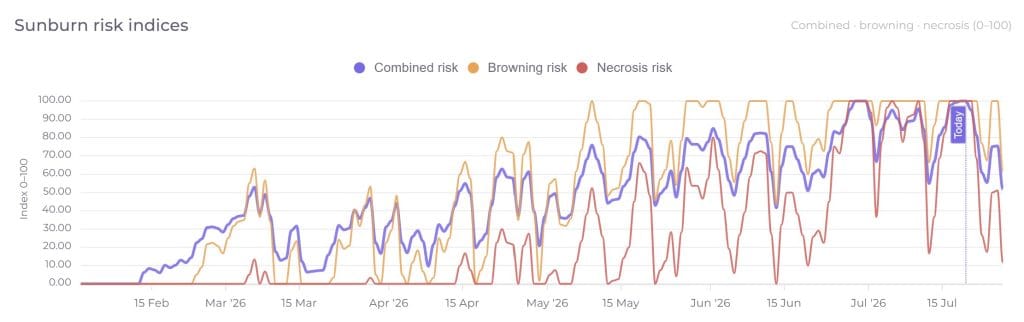
Predicting apple sunburn requires far more than monitoring maximum air temperature. The thermal environment experienced by an apple is governed by a complex interaction of atmospheric conditions, orchard architecture, and crop physiology.
Orchardly addresses this challenge through a multi-layered environmental intelligence engine that continuously analyses weather observations, short-term numerical weather forecasts, orchard microclimate characteristics, and crop phenology to model the thermal conditions experienced by developing fruit.
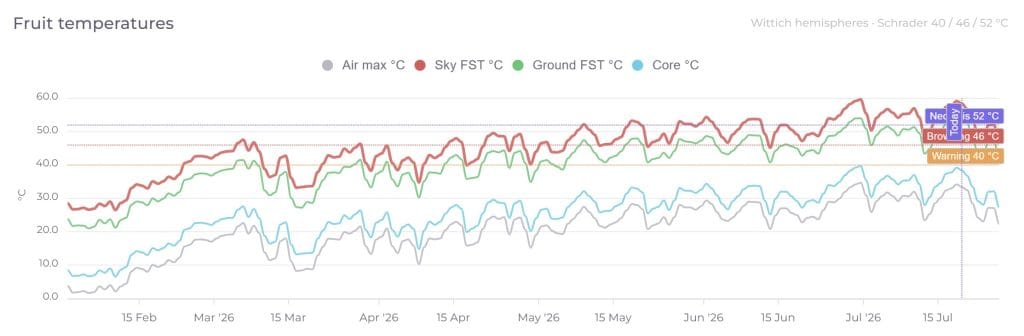
The platform dynamically evaluates a broad range of variables, including solar irradiance, air temperature, relative humidity, vapour pressure deficit (VPD), wind speed and direction, cloud cover, accumulated heat load, orchard topography, slope orientation, canopy characteristics, irrigation status, and forecast weather transitions. These environmental signals are synthesized into a dynamic Sunburn Risk Index that estimates the probability of fruit surface temperatures approaching scientifically established injury thresholds.
Unlike conventional weather applications that report generic forecasts, Orchardly contextualizes environmental data using orchard-specific conditions and evolving crop growth stages to generate highly localized, actionable advisories. This enables growers to identify high-risk windows well before irreversible damage occurs, optimize irrigation scheduling, postpone canopy-altering operations, and implement preventive interventions at the right time.
By combining precision weather analytics, crop physiology, and predictive agronomy, Orchardly transforms complex environmental data into practical, orchard-specific decision support—helping growers protect fruit quality, improve pack-out percentage, and reduce climate-related losses.
Frequently Asked Questions
Can apples recover from sunburn?
No. Once fruit tissue has been damaged by sunburn, the affected area cannot regenerate. The objective is early prevention rather than treatment.
Does irrigation prevent sunburn?
Irrigation cannot completely prevent sunburn, but maintaining adequate soil moisture reduces tree stress and improves natural cooling through transpiration, lowering overall risk.
What weather conditions are most dangerous?
The highest risk occurs when high temperatures coincide with intense solar radiation, low humidity, high VPD, light winds, and prolonged heat waves.
Is air temperature enough to assess sunburn risk?
No. Fruit surface temperature, influenced by multiple environmental variables, is a much more reliable indicator of potential sunburn injury than ambient air temperature alone.
Final Thoughts
Apple sunburn is no longer an occasional seasonal issue—it is becoming a recurring challenge as summers grow warmer and weather patterns become more unpredictable. Fortunately, growers who combine sound orchard management with timely environmental intelligence can significantly reduce heat-related losses.
Preventing sunburn is not about reacting after fruit has been damaged; it is about anticipating risk before temperatures reach critical thresholds. By integrating modern weather analytics, orchard-specific insights, and predictive decision support, growers can make informed management decisions that safeguard fruit quality, maximize pack-out, and improve long-term orchard profitability.
As climate-smart horticulture continues to evolve, proactive monitoring will become an essential component of sustainable apple production—and technologies like Orchardly are helping growers stay one step ahead of the weather.